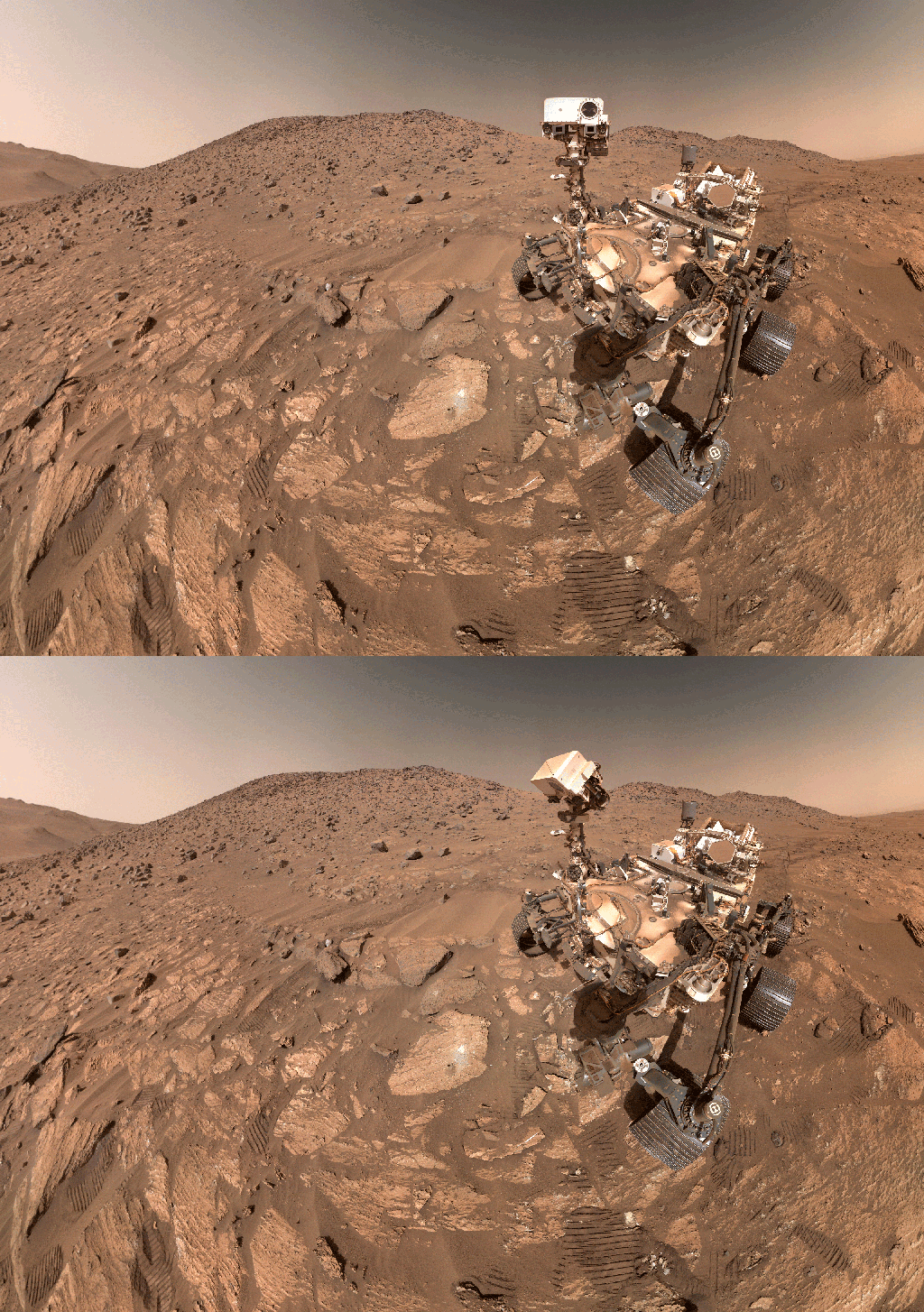
The Mars 2020 Perseverance Rover at “Cheyava Falls”, a light-colored rock layer in the ~3.5 billion-year-old Jezero crater that might preserve residues (biosignatures) of ancient life
I’m a postdoctoral researcher in Briony Horgan’s Planetary Surface Processes Lab at Purdue University and a scientist on the NASA Mars 2020 Perseverance Rover’s Mastcam-Z team.
I am interested in the alteration history and biosignature preservation potential of rocks at Jezero crater, Mars. Some of my past work includes stable isotope paleoclimatology, mineralogy, and diagenesis of Mars-analog paleosols from Oregon; Ediacaran paleontology and alteration history of rocks at the Precambrian-Cambrian boundary; weathering on land leading up to Neoproterozoic snowball Earth; and organic preservation in Archean (3.0-3.7 Ga) nonmarine rocks from Australia and Greenland.
My work with Mastcam-Z seeks to understand the composition, geological history, and biosignature preservation potential of rocks at Jezero Crater, and to link observations from Mastcam-Z with observations from orbital satellites.
I graduated from the University of Oregon in 2022. My dissertation research examined the remarkable connections between soils, plants, geology, and climate change.
For this work, I used a variety of tools to examine buried, fossil soils (paleosols) from the 3.7-billion-year geological record on Earth. Paleosols form when soil is buried rapidly, like during a volcanic eruption, dust storm or flood event. Over time, the soil “fossilizes” and turns into a sedimentary rock.
The mineralogy and geochemistry of terrestrial paleosols stores a record of the interaction between a planet’s atmosphere and it’s surface, allowing for detailed estimates of ancient climate conditions on land. Because of rapid burial, many paleosols contain fossils, so I also use fossils in paleosols to understand the origin and evolution of life across the surface of the Earth, and to determine how life responded to past climate change events. Beyond Earth, I use Mars-analog paleosols to understand the ancient Martian climate as well as to constrain the best places on the surface of Mars to search for past signs of life. Put simply, my research seeks to understand the origin and evolution of life on Earth, as well as to investigate the possibility for life to have existed on the surface of Mars billions of years ago.
 Mars-analog paleosols: Oligocene (~33 million year old) paleosol sequences at the Painted Hills Unit of the John Day Fossil Beds National Monument, eastern Oregon. Paleosols here formed from the weathering of volcanic ash and tuff parent material emplaced on alluvial terraces millions of years ago. Red paleosol layers (Alfisols) formed in well-drained, oxidizing conditions while yellow layers (Inceptisols) formed in poorly-drained seasonally reducing environments and have prominent reduced Mn-oxide bearing horizons (black layers, Bg horizons). Photo: William Horton.
In particular I am interested in understanding past climates on Earth by examining paleosols, and understanding the nature of soil development and biosignature preservation in very old paleosols of Earth and Mars.
 Possible paleosol sequence on Mars at Mawrth Vallis, This area is approximately 3.7 – 4.1 billion years old, and shows striking spectral similarity to paleosol sequences on Earth (Photo: NASA/JPL-Caltech/University of Arizona).
I am fascinated with the interconnectedness of the natural world. The coeval influence of physical, chemical and biological processes acting upon the surface of the Earth is nothing short of remarkable. Simmered down to its essence, this is what drives my desire to study the natural world, and keeps me excited to wake each morning, soiled with science.
 Pholisma arenarium, parasitic “sand plant”, Mescal ridge, Big Sur, CA
 Planetary Soils