2024 Update: This work was recently published in Nature Scientific Reports. Check it out!
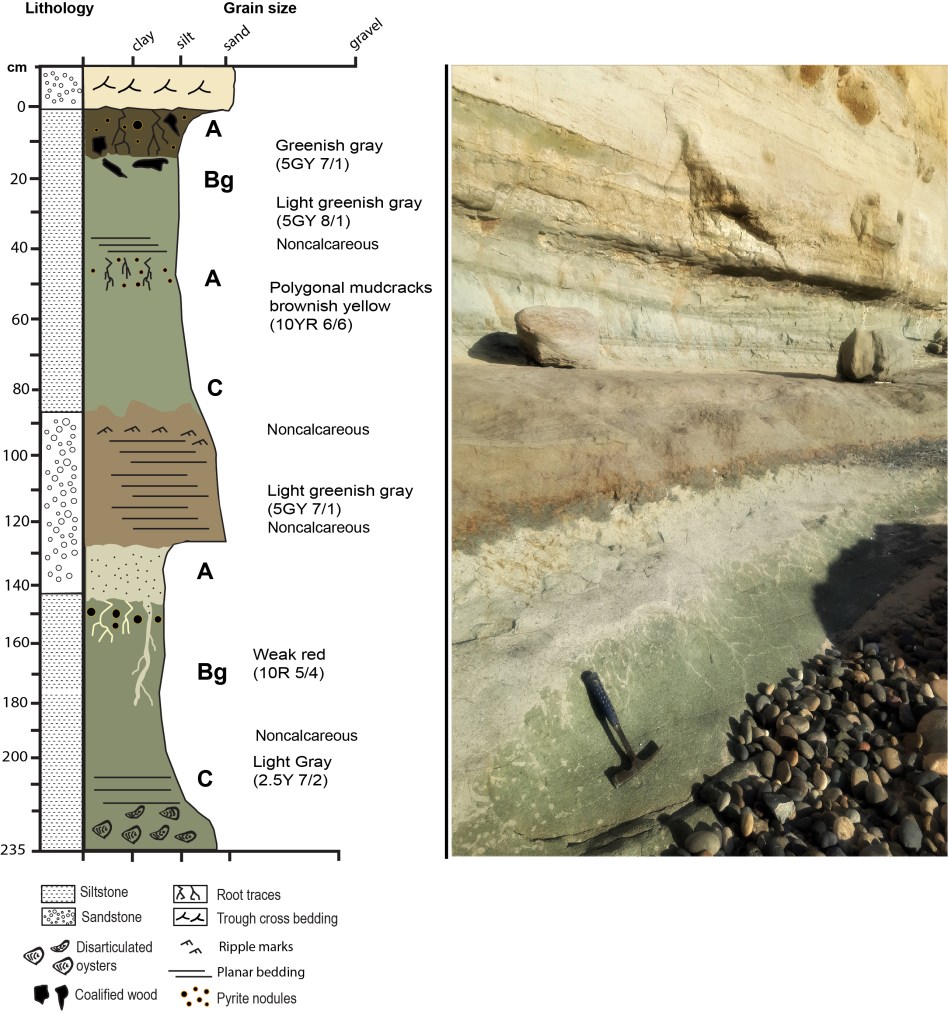
A few years ago, we were surfing at Cardiff-by-the-Sea over the magical reefs that lend the area incredible surfing conditions and shapely wave formation. Something out of the ordinary caught my eye – paleosols sandwiched in the beach cliff! At the south end of San Elijo State Beach, near the rivermouth – there was a perfectly preserved sequence of three deeply weathered paleosols (ancient, buried soils). Even more exciting was the realization that Cardiff Reef itself (the shore platform extending out to sea) was part of the paleosol sequence! Who could have imagined – surfing atop an ancient soil!
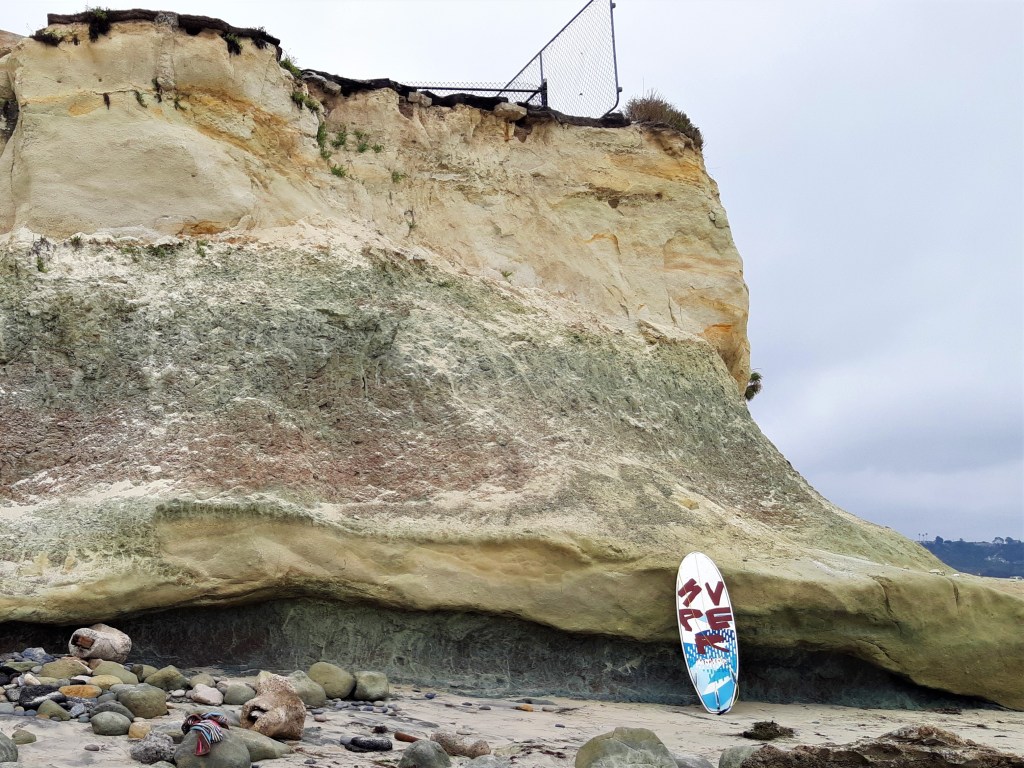

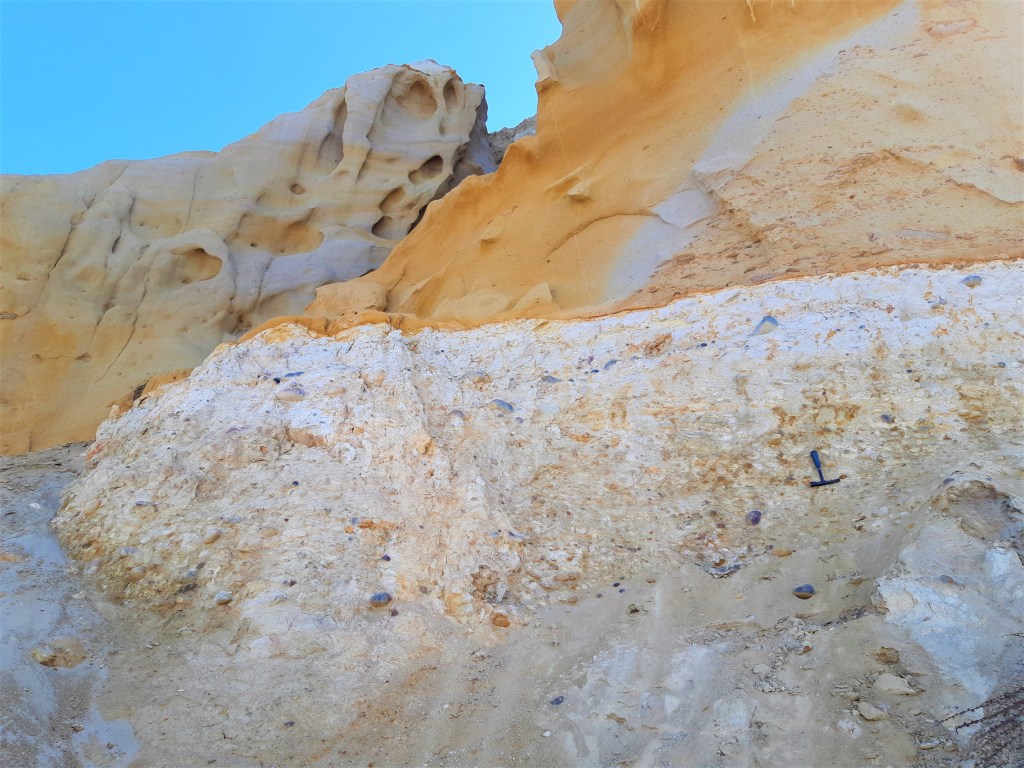
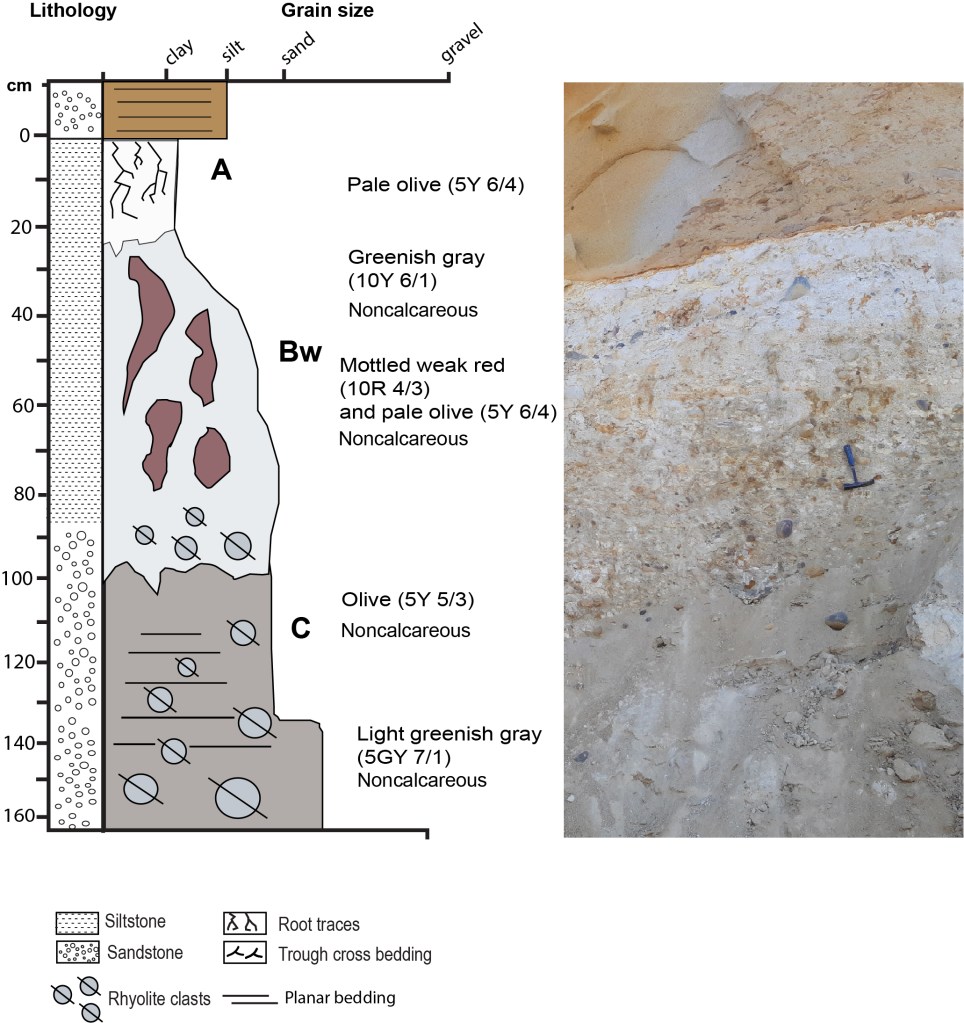
After a short review of the geological history of the region, it was apparent that we were dealing with REALLY OLD soils – between 50 and 55 million years old! Even more exciting was that these soils had the telltale signs of intense, tropical weathering: the profiles were dominated by kaolinite and were very thick, approximately 3 meters deep. So, our surfing/geology side project began. We returned in January of 2021 to describe and sample the ancient soils at three locations where they are naturally exposed in the beach cliffs: San Elijo, Black’s Beach, and Torrey Pines. The objective of this work was to constrain the paleoclimate conditions (mean annual precipitation, mean annual temperature) during soil formation. Critically, this period in geological history (known as the Paleocene-Eocene “thermal maximum” was the last time that atmospheric CO2 was as high as is projected for the year 2100 (between ~1000 and 2000 ppmv CO2, we are currently at ~420 ppmv). Therefore, studying soils of the past can help to constrain how climate and ecosystems will respond to modern global warming, and provide unprecedented insight into the climate evolution of present day southern California during the Paleocene-Eocene thermal maximum.
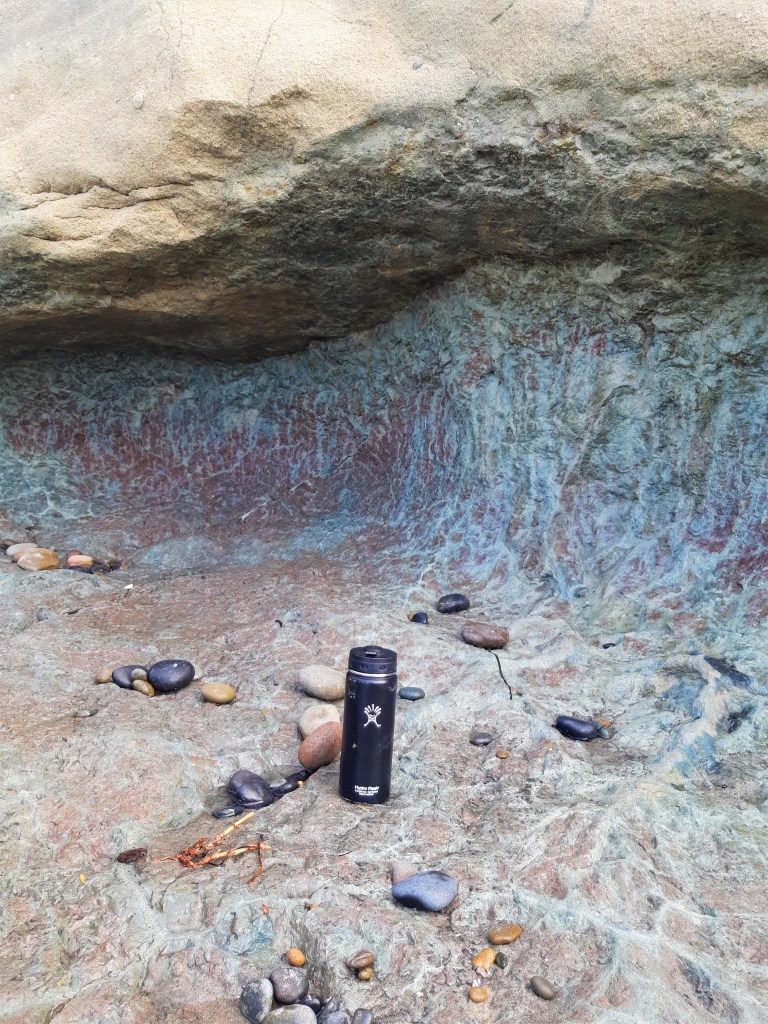
Abstract: Nonmarine rocks in sea cliffs of southern California store a detailed record of weathering under tropical conditions millions of years ago, where today the climate is much drier and cooler. This work examines early Eocene (~ 50–55 million-year-old) deeply weathered paleosols (ancient, buried soils) exposed in marine terraces of northern San Diego County, California, and uses their geochemistry and mineralogy to reconstruct climate and weathering intensity during early Eocene greenhouse climates. These Eocene warm spikes have been modeled as prequels for ongoing anthropogenic global warming driven by a spike in atmospheric CO2. Paleocene-Eocene thermal maximum (PETM, ~ 55 Ma) kaolinitic paleosols developed in volcaniclastic conglomerates are evidence of intense weathering (CIA > 98) under warm and wet conditions (mean annual temperature [MAT] of ~ 17 °C ± 4.4 °C and mean annual precipitation [MAP] of ~ 1500 ± 299 mm). Geologically younger Early Eocene climatic optimum (EECO, 50 Ma) high shrink-swell (Vertisol) paleosols developed in coarse sandstones are also intensely weathered (CIA > 80) with MAT estimates of ~ 20 °C ± 4.4 °C but have lower estimated MAP (~ 1100 ± 299 mm), suggesting a less humid climate for the EECO greenhouse spike than for the earlier PETM greenhouse spike.

 Planetary Soils
That is incredibly awesome! Thanks for bringing to light for me something that before was buried to my understanding.
LikeLike